
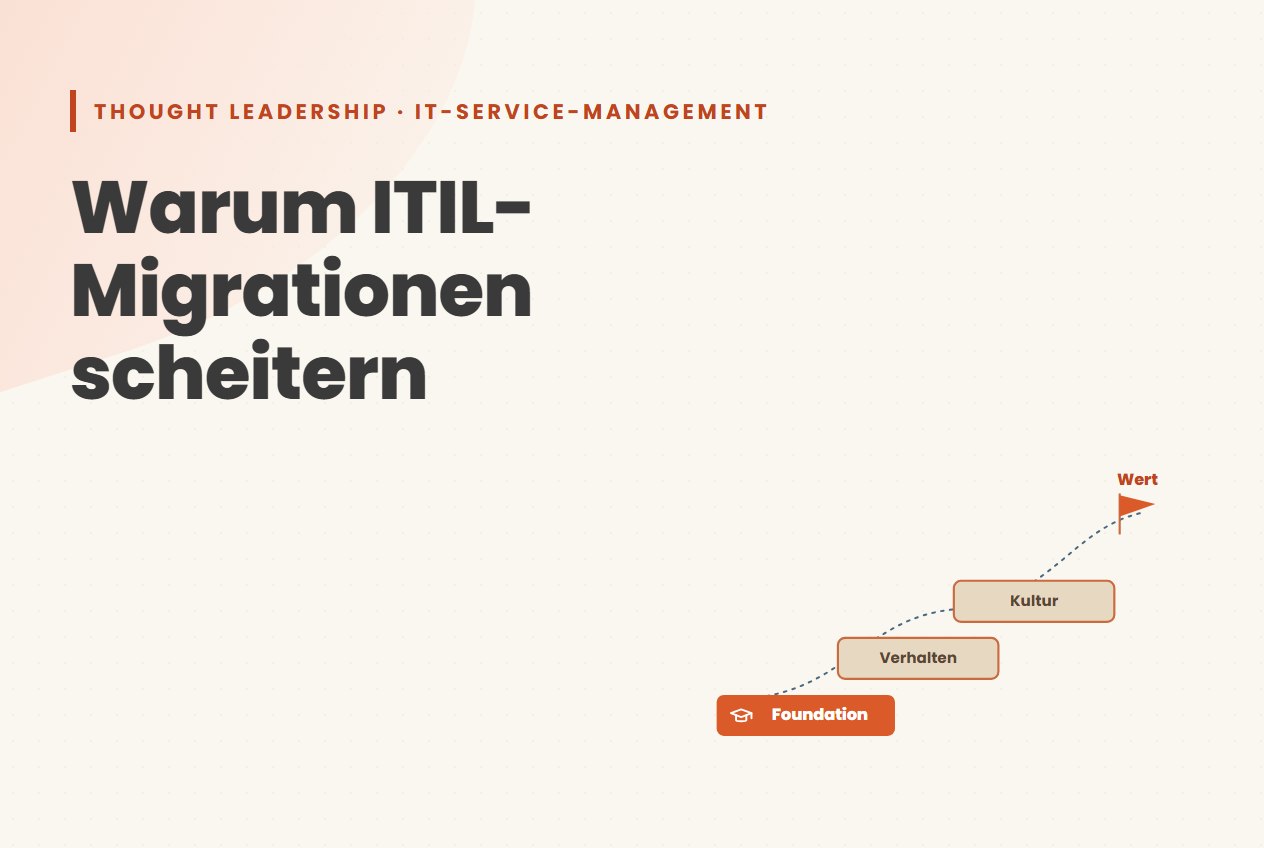
Why so many ITIL rollouts end with framed certificates on the wall — and change nothing in daily work.
Many organisations roll out ITIL by sending their staff to training. Six months later, the certificates hang framed on the wall, and in daily work nobody operates any differently than before. That is no coincidence — it is the logical consequence of a flawed premise: anyone who treats an ITIL migration as a change of methodology has already missed the point. It is about culture.
1. The familiar picture
The decision has been made: "We are rolling out ITIL." A training provider is commissioned, twenty employees attend the three-day Foundation course, everyone passes the exam. The certificates get framed, the project is considered complete. Box ticked.
Six months later, a closer look tells a different story. Incidents are still resolved by shouting across the coffee machine. Changes bypass the process because "it's faster that way." The new service management tool is used as a pricier version of the old ticketing system. The terms have changed — "fault" became "incident." The behaviour has not.
What happened? Nothing. And that is exactly the problem.
2. The Foundation trap
The Foundation certificate is a useful instrument. It creates a shared vocabulary and a basic understanding of the concepts. But that is exactly what it measures: vocabulary and conceptual knowledge. It does not measure whether someone is ready to work differently, to distribute responsibility differently, or to let go of familiar routines.
This is where the consequential conflation sets in: "We trained our people" gets mistaken for "We rolled out ITIL." One is a prerequisite, the other an outcome. Between the two lies the actual work — and that only begins after the exam.
A Foundation course changes one person's knowledge over an afternoon. A migration changes how an entire organisation works together. That takes months to years. Anyone who treats the certificate as the destination has ended the journey before it began. That is the Foundation trap: it mistakes the entry ticket for the arrival.
3. Migration is culture change, not a tool swap
So what does an ITIL migration actually consist of? Not the new tool. Not renamed processes. Not a set of document templates.
It consists of a change in behaviour. Teams that used to work in silos are meant to coordinate along value streams. Staff who processed tickets are meant to put customer value at the centre. Managers who steered by utilisation are meant to steer by outcomes. These are not process questions. They are culture questions.
That is precisely why migrations that operate solely at the tool and process level fail. You can roll out a new tool in weeks. You can draw process diagrams in days. But you cannot mandate that people trust one another, take ownership, and think beyond departmental boundaries. The tool changes quickly; the mindset behind it needs time, role models, and patience.
ITIL 4 knows this itself, for that matter. The Guiding Principles — among them "Focus on value," "Collaborate and promote visibility," and "Progress iteratively with feedback" — are, at their core, behavioural rules, not technical requirements. Anyone who ticks them off as required reading for the exam, instead of living them, has read ITIL but not understood it.
4. "Start where you are" properly understood
No Guiding Principle is misused as often as "Start where you are." In practice, it is often heard as a justification for standing still: "We're starting from where we are, so let's not change anything for now." That is the exact opposite of what is intended.
"Start where you are" calls for an honest stocktake before touching anything. Look closely at what is really there. No tearing things down for its own sake — but no standing still as a comfort zone either.
These are the questions the principle is asking: What already works? Which existing practices are usable? Where do the real problems lie — not the ones described in the textbook?
Anyone who overlooks this replaces things that already work at great expense, and in doing so squanders the organisation's trust before the migration has properly begun.
5. What actually works
What helps when training and tooling alone are not enough? Culture change cannot be mandated, but it can be shaped. Four levers have proven themselves in practice:
- Small value streams instead of a big bang. Do not convert the whole organisation at once — start with one concrete, visible value stream. A success everyone can see convinces more than any training slide.
- Visible leadership. Culture change fails when management delegates it. When leaders themselves act on the new principles — for instance, aligning decisions with customer value — the organisation follows. If they do not, it follows too: the old pattern.
- Feedback loops. "Progress iteratively with feedback" applies to the migration itself as well. Ask regularly what is working and what is not, and adjust course, rather than pushing through a two-year plan that is outdated after three months.
- Adjusting incentives. People do what they are rewarded for. As long as utilisation is measured, utilisation gets optimised, not value. Anyone who wants to change behaviour must change what gets measured and recognised.
Conclusion: The migration is a journey, not a project
An ITIL migration is not a project with a closing date that ends with the last certificate. It is a culture change. Culture does not change in the training room — it changes in daily work, through many small decisions. The Foundation certificate is the start of that journey, not its destination.
Anyone who internalises this asks the right questions: not "Have we rolled out ITIL?" but "Are we working together in a more value-oriented way today than yesterday?" That is exactly where we come in at Qudits: we do not accompany organisations to the certificate — we accompany them through the change behind it.
Our practical tip: Do not ask "Is everyone trained?" Ask "What are we demonstrably doing differently today than six months ago?" The first question measures activity. The second measures change. Only the second one counts. It shows you whether anything has really changed — or whether it is just the framed certificates hanging on the wall.
Request a no-obligation conversation

Florian Nitz is a Consultant at Qudits AG and an ITIL 4 Managing Professional. He is responsible for technical and digital projects — from IT service management to the further development of digital platforms — and combines strategic clarity with pragmatic execution.

Thomas is Executive Partner at Qudits AG and an ITIL V3 Expert. His focus lies in managing complex IT programmes and projects — particularly in the life sciences — as well as in building and continuously improving IT service management organisations. He develops teams and people with passion.