
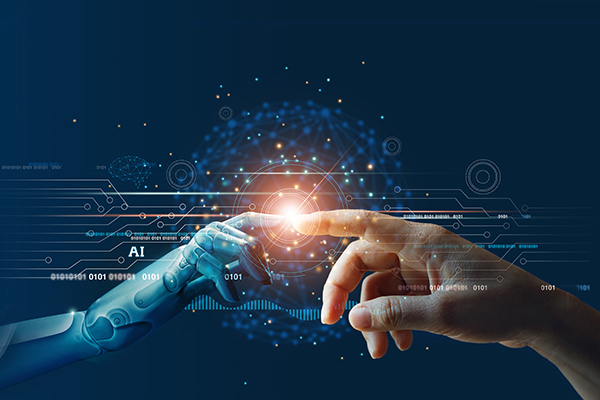
Artificial intelligence is firmly integrated into our daily lives. It is developing faster than expected and in some cases already surpasses human decision-making. From talking devices to digital assistants, cooperative robots and autonomous vehicles to drones – it is everywhere and takes over routine tasks in the workplace. It is becoming increasingly difficult to distinguish between bots and humans in digital media.
Ongoing digitalisation affects all economic sectors and has its origins in big data and American internet companies. Machine learning methods on high-performance hardware and software platforms provide artificial intelligence with the tools to learn from large datasets with complex relationships without explicit programming.
Classification of artificial intelligence
Artificial intelligence
Artificial intelligence (AI) is an umbrella term for applications in which machines approximate important functions of the human brain such as learning, judging and problem-solving, and provide human-like intelligence. This includes machine learning, natural language processing and deep learning.
Systems are generally distinguished between:
- Weak artificial intelligence: a machine that can replicate individual cognitive abilities of humans and perform certain tasks, but has neither creativity nor explicit abilities to learn independently in a universal sense.
- Strong artificial intelligence: a machine that generally has the same capabilities as humans and can therefore fulfil any intellectual task. We have so far only seen concrete examples in science fiction.
- Superintelligence: a machine that not only reaches but surpasses human capabilities and can acquire new knowledge completely independently.
Machine learning
Machine learning is a subfield of artificial intelligence and computer science that deals with the use of data and algorithms to imitate the way humans learn and to improve accuracy incrementally.
Deep learning
Deep learning is a specific method of information processing and a subset of machine learning that uses neural networks to analyse large datasets. Deep learning models are characterised by their ability to learn – humans no longer intervene in the actual learning process.
Use cases from various industries
- Healthcare: predictive analytics forecasts the future based on historical data, e.g. the necessity of surgery considering risks.
- Banking and finance: using natural language processing, insurance companies can analyse large volumes of text and identify key factors for claims.
- Automotive: AI-based robotics combined with human workers enables tasks in manufacturing and supply chains.
- Manufacturing: AI is successfully used for advanced data analysis, providing enormous help with risk management and decision-making.
- Education: AI tailors teaching through personalised learning for individual students.
- Retail: intelligent assistants provide customers with automated responses and professional advice.
- Telecommunications: conversational AI helps companies manage massive customer support traffic and reduce waiting times.
Artificial intelligence as a complement to humans
The role of AI in the workplace is often misunderstood, with people saying that machines should replace humans. The replacement of human workers by artificial intelligence presupposes that humans and AI have the same characteristics and capabilities. In reality, this is far from the case. Faster, more accurate and consistently rational – this is how AI-based machines can be described. What they lack, however, is intuition, emotions and cultural sensitivity.
Humans therefore represent authentic intelligence – another kind of AI, so to speak. At the same time, creativity is required when it comes to developing a vision and a future strategy.
Challenges in the use of AI systems
A major risk in the use of AI is that humans forget how to make correct decisions in complex situations – so-called deskilling. AI should therefore only be used as a tool to extend cognitive abilities. The use of AI creates a black box through which decisions can no longer be interpreted or verified.
Depending on the area of application, data protection is often a major obstacle. An additional challenge is the distorted data situation, the so-called bias. Especially in the medical environment, the question of additional regulations at state level needs to be clarified.
Outlook for the future
The greatest opportunity, but also the greatest risk, lies in the complementary use of AI and humans. AI is not a replacement for human labour, but a complement. The full potential of AI can only be exhausted when insight is gained into this black box and human expertise is allowed to play a role.
In short: technology serves as a tool, while the company remains responsible. If this symbiosis of human and machine succeeds, it will promote the development of a new generation of products and services.