
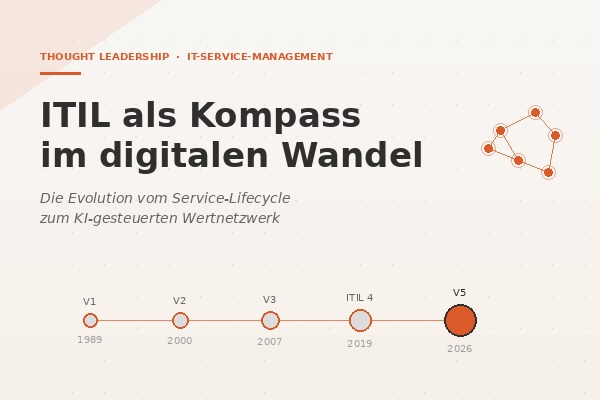
For more than 40 years, the Information Technology Infrastructure Library (ITIL) has been the world's most widely adopted standard for IT Service Management (ITSM) — yet with the release of ITIL (Version 5) in February 2026, the framework responds to a fundamentally changed operational reality: AI, automation and platform-based delivery models are now at the core of IT service delivery.
Studies confirm a global adoption rate of around 72% of all organisations (Avasant, 2026) — in the German-speaking world this figure is 75%, even higher than in other regions (Marrone et al., 2014). In the DACH region, operational processes such as Incident Management have reached 95% adoption and are now widely considered standard practice (AXELOS State of ITSM, 2022). Yet ITIL is not a static structure. It is a living compass that continuously adapts to technological reality.
This article explores what has changed, why it matters — and what you, as an IT decision-maker in the public sector or a mid-sized organisation, should do now.
1. Looking Back: Stability Through Structure (ITIL v3)
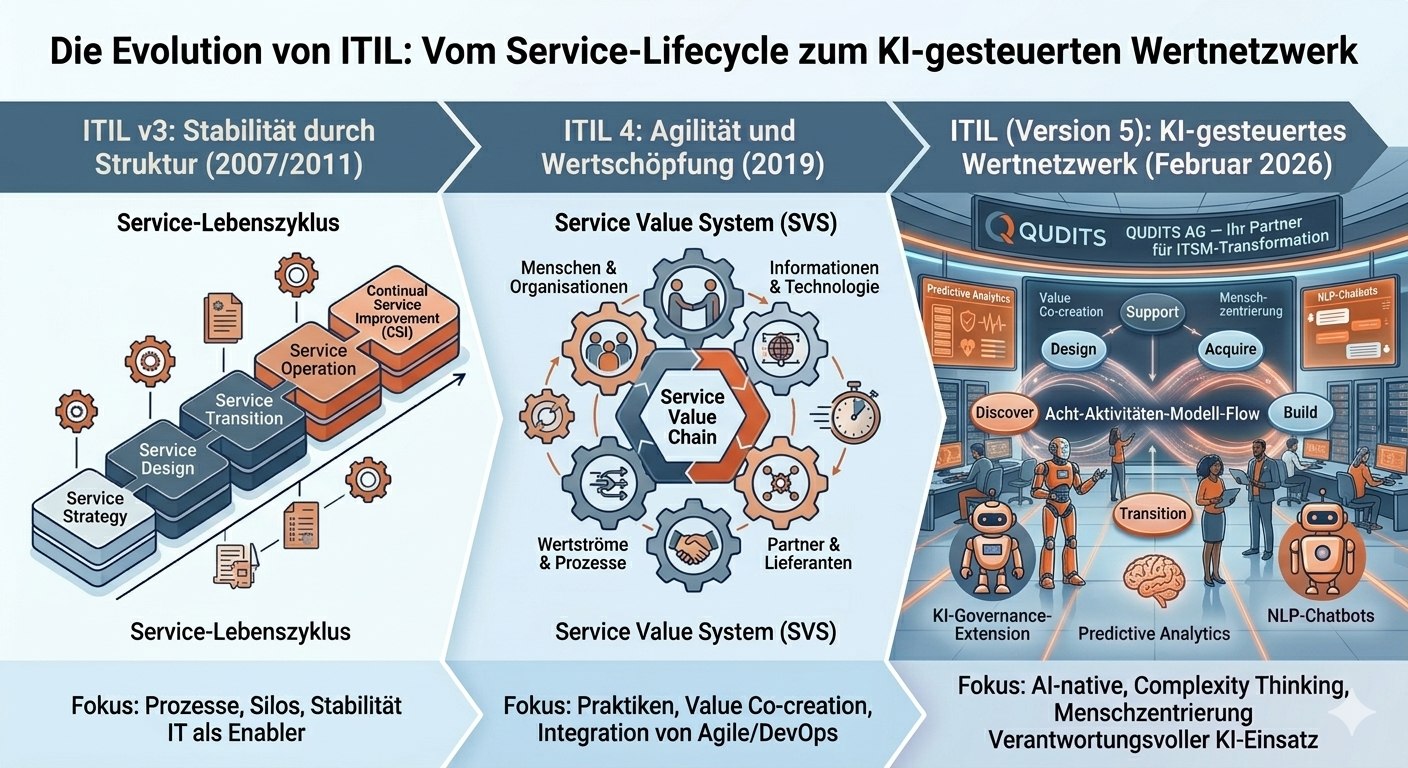
Introduced in 2007 and revised in 2011, ITIL v3 shaped the thinking of an entire generation of IT managers through its Service Lifecycle model. In that era, IT was understood primarily as a means to an end — an enabler of business objectives whose main task was stability and predictability.
The framework was structured around five sequential phases:
- Service Strategy — Define strategic objectives and the service portfolio
- Service Design — Design new or changed services
- Service Transition — Transfer designs into live operation
- Service Operation — Ensure day-to-day operations
- Continual Service Improvement (CSI) — Optimise incrementally
The model delivered what IT departments needed at the time — clear responsibilities, traceable processes and auditability. The downside was that many organisations developed process silos in which design teams had no visibility of operational issues and the strategic perspective became lost in day-to-day operations. With the rise of DevOps and Agile, ITIL v3 came under increasing criticism — too rigid, too sequential, too little focused on speed.
2. A Paradigm Shift: Agility and Value Creation (ITIL 4)
With ITIL 4 (2019) the framework underwent a fundamental transformation. Linear process sequences gave way to the Service Value System (SVS) and its Service Value Chain — the answer to a question many organisations were grappling with: how can we deliver faster without losing control?
The Three Key Innovations
- From process to practice: ITIL 4 replaced isolated processes with 34 management practices — holistic organisational capabilities rather than task sequences.
- Value co-creation: The focus shifted from mere service «delivery» to the joint creation of value between provider and customer.
- Integration of modern methods: Agile, DevOps and Lean were integrated directly into the framework — as equal partners, not as add-ons.
The four dimensions of the ITIL 4 model — Organisations & People, Information & Technology, Partners & Suppliers, and Value Streams & Processes — remained one of the most important constants across all versions. Only by considering all four dimensions simultaneously can sustainable value be generated.
3. The Future Is Now: ITIL (Version 5) and the AI Revolution
On 12 February 2026, PeopleCert published the latest iteration: ITIL (Version 5) (PeopleCert, 2026). Not a reset, but an evolutionary response to a fundamentally changed operational reality. The framework addresses what ITIL 4 had not anticipated: organisations in which AI, automation and platform-based delivery models are not an add-on but the core of IT service delivery.
What Is Genuinely New?
ITIL 5 introduces a revised Value System. Products and services are no longer separate entities; they are designed, delivered and improved in a single continuous end-to-end flow. Specifically, an eight-activity model replaces the previous Service Value Chain:
- Discover — Understand the environment and identify opportunities
- Design — Shape solutions and services
- Acquire — Procure resources and capabilities
- Build — Develop and configure
- Transition — Move from development to live operation
- Operate — Keep services running in production
- Deliver — Bring value to the customer
- Support — Handle requests and incidents in operation
AI-native: What This Means in Practice
ITIL 5 is the first ITSM framework to explicitly integrate AI governance into its core structure. This is not a cosmetic addition — it is a response to a market development that is accelerating rapidly:
- 40% of all enterprise applications will have integrated task-specific AI agents by the end of 2026 (Gartner, 2025) — up from fewer than 5% in 2024.
- 85% of customer service and support organisations are already using generative AI to boost employee productivity (Gartner, 2025).
- Only 11% of organisations have agentic AI in productive use — 38% are in the pilot phase (Deloitte Tech Trends, 2026).
- The global ITSM software market is forecast to grow from USD 4.5 billion (2026) to USD 9.6 billion (2035), driven by AI and cloud integration (Grand View Research, 2024).
ITIL 5 responds to this reality with a dedicated AI Governance Extension. It provides organisations with guidance for the responsible use of machine learning, natural language processing and generative AI — ethically, transparently and with a focus on value. Added to this are the principle of Complexity Thinking for unpredictable environments and Industry 5.0 human-centricity as a design principle.
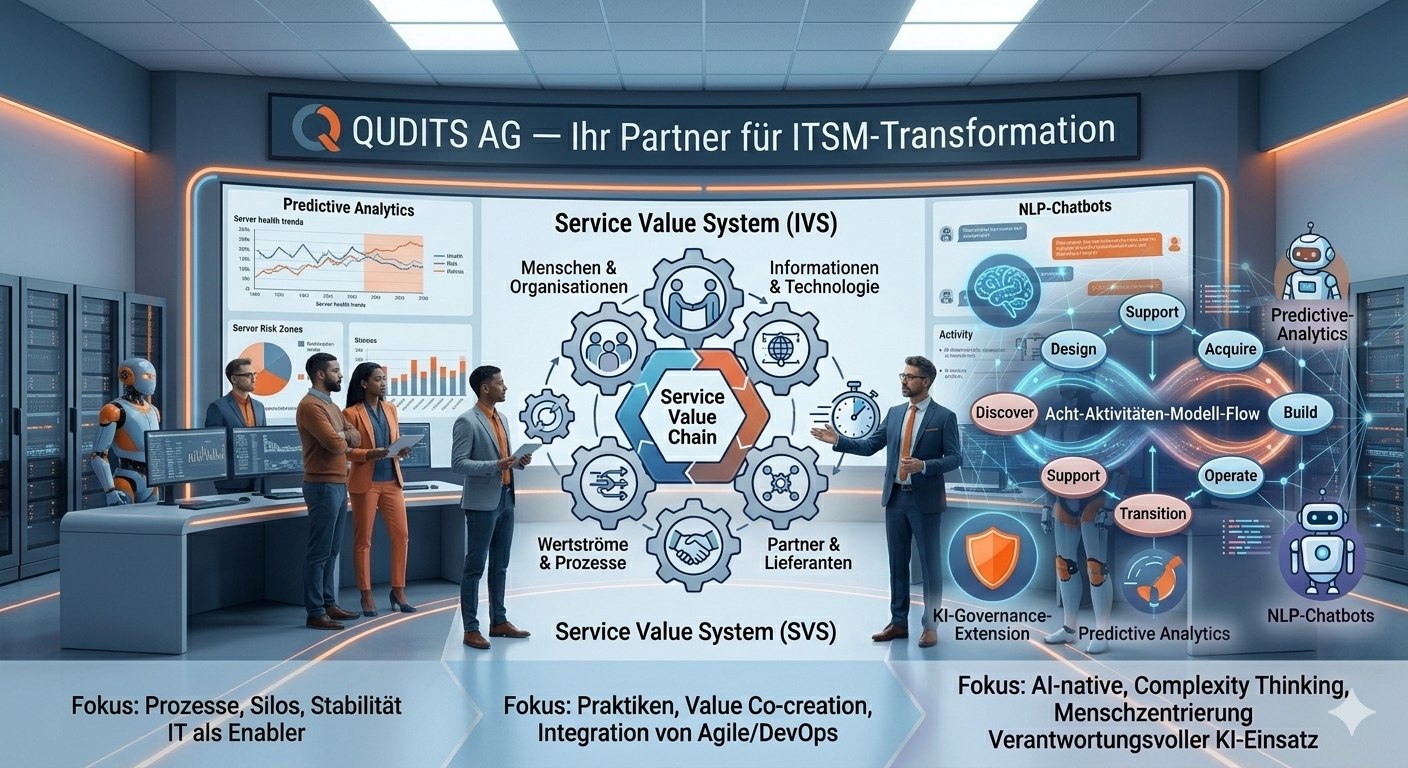
What this means in practice: AI does not take over service management — it changes how value is created. Predictive analytics detects server failures before they occur. NLP chatbots resolve up to 60% of Tier-1 tickets without human intervention, according to vendor data (industry studies, ITSM vendors, 2024). Automated change pipelines reduce release cycles from weeks to hours. ITIL 5 gives IT teams the governance framework to manage this transformation in a structured way — without neglecting the human factor.
4. ITIL in the Public Sector and Mid-Market: Where Do Swiss Organisations Stand?
For IT decision-makers in cantonal authorities, public bodies or mid-sized companies, the question is what this transformation means for them specifically.
The good news: the DACH region has a strong ITIL foundation. With a 75% adoption rate, German-speaking countries are significantly ahead of the US or Australian average. Operational processes such as Incident Management are broadly established.
The challenge lies at the tactical-strategic level — studies show Service Level Management at only 58% adoption (AXELOS State of ITSM, 2022). And for most public-sector organisations, the integration of AI into existing ITSM structures is still in its early stages.
Three Areas of Action for IT Decision-Makers
- Governance before technology: Before introducing AI tools, clear roles, transparency obligations and escalation paths are needed. ITIL 5 provides the framework for this.
- Make value visible: Use the value co-creation logic of ITIL 4/5 to translate IT performance into business value — especially in dialogue with executive leadership or administrative management.
- Digital Product Management: ITIL 5 promotes the transition from the classic «service provider» to the «digital product owner». This is cultural change — and for many IT teams, the real challenge ahead.
5. Conclusion: Start Where You Are — But Know Where You Are Heading
The evolution from ITIL v3 through ITIL 4 to Version 5 follows a clear logic — from process stability through agile value creation to AI-ready service management. Each version was a response to the complexity of its time.
For IT organisations in the public sector and mid-market, this does not mean switching to ITIL 5 immediately. It means knowing where you stand — and developing a clear vision of where you want to go.
Apply the ITIL principle of «Start where you are»: begin by analysing your current maturity level. Operational processes such as Incident Management are often ideal starting points for modernisation — they deliver quick, visible added value and lay the foundation for future AI integration.
Concrete next steps:
- Maturity assessment: Where do you stand today relative to ITIL 4 practices?
- Identify quick wins: Which process would benefit most immediately from AI support?
- Develop a roadmap: A step-by-step, low-risk path from ITIL 4 to Version 5.
Request a no-obligation conversation

Thomas is Executive Partner at Qudits AG and an ITIL V3 Expert. His areas of focus include the management of complex IT programmes and projects — particularly in the Life Sciences sector — as well as the establishment and continuous improvement of IT Service Management organisations. He is passionate about developing teams and people.